



The News
Democrats’ jubilation over the prospect of claiming four new Virginia House seats evaporated on Friday, cementing a new GOP advantage in the mid-decade congressional redistricting war.
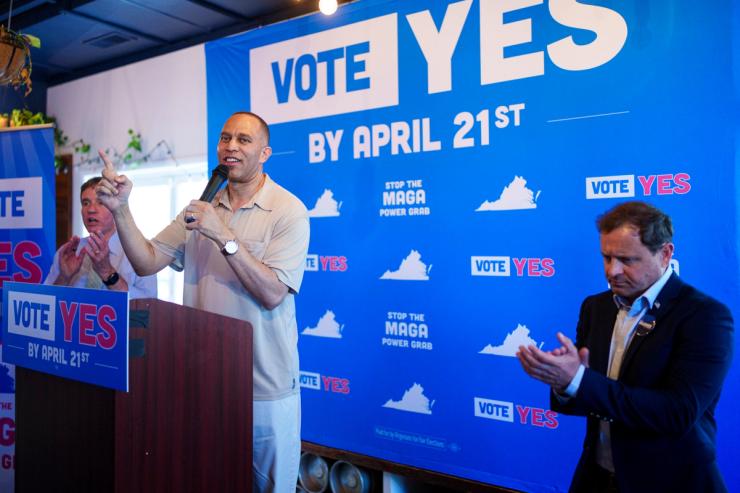
In a 4-3 decision, the Virginia Supreme Court tossed the state’s Democratic-led remapping that voters approved late last month after House Minority Leader Hakeem Jeffries and his allies sunk tens of millions of dollars into the high-risk, high-reward effort.
Jeffries and other top Democrats saw Virginia as a pivotal offset to Republican redistricting pushes in Texas and other red states that President Donald Trump has cheered. After an initial struggle to align in favor of aggressive blue-state redistricting, Virginia was supposed to be proof that Democrats could match Trump in the redistricting fight.
But the Virginia ruling, alongside a Supreme Court decision that weakened the Voting Rights Act and sparked GOP-led redraws underway across the South, is a huge setback. Democrats responded by making clear that, with voters souring on Trump’s stewardship of the economy and the Iran war, they still see the House majority as theirs for the taking.
“Our democracy was founded on the belief that the people have the final say. In November, they will, and they’ll power Democrats to the House majority,” DCCC Chair Rep. Suzan DelBene, D-Wash., said in a statement.
The party is still confident it can flip two of Virginia’s five GOP-held seats using the state’s pre-redistricting maps: the 1st District, held by Rep. Rob Wittman, has trended bluer in recent years, and the bellwether 2nd District held by Rep. Jen Kiggans.
The likely Democratic nominee in the 2nd District, former Rep. Elaine Luria, said the ruling didn’t change her plans: “We will continue our campaign’s momentum into November to flip this seat, fight for working families, and get to work for the Virginians who are being left behind by Jen Kiggans and Donald Trump.”
But the state court’s decision is going to dash Democrats’ chances elsewhere in Virginia, where they had initially lined up to run in a redrawn map that would have created 10 Democratic-favored seats.

Know More
The state Supreme Court agreed with the Republican plaintiffs, who argued that by moving the redistricting ballot question in a special session weeks before the 2025 election, Virginia Democrats didn’t follow state law that dictates the timing of ballot measures.
“The Commonwealth submitted a proposed constitutional amendment to Virginia voters in an unprecedented manner that violated the intervening-election requirement in Article XII, Section 1 of the Constitution of Virginia,” wrote Justice D. Arthur Kelsey in his opinion for the majority. “This violation irreparably undermines the integrity of the resulting referendum vote and renders it null and void. ”
The GOP had raced to the courthouse at every stage of the process — first when former state Attorney General Jason Miyares had the power to challenge the Democrats’ plan, then when their attorneys could file in a friendly district to slow down the map. During their unsuccessful electoral campaign to defeat the new maps, Republicans highlighted the legal confusion around the vote and urged judges to stop it.
“I specifically have asked our Supreme Court of the Commonwealth of Virginia to do your job and declare this unconstitutional,” former Gov. Glenn Youngkin said at a rally in a GOP stronghold shortly before the vote.
Republicans don’t expect similar legal challenges to their new redistricting push in Florida, which Democrats and civil rights organizations say is a violation of that state’s voter-passed Fair Districts Amendment of 2010.
Florida’s conservative Supreme Court has rarely ruled against GOP Gov. Ron DeSantis’ administration. DeSantis’ team argues that the 2010 statute is likely not enforceable, given that it included race-based remapping requirements of the sort that the US Supreme Court recently struck down.
The GOP’s other ongoing pushback against Democratic remapping gains is in the unlikely battleground of Utah. Republicans there have expanded the state Supreme Court from five seats to seven, hopeful that two new appointees could reverse a decision that created a Democratic House seat in Salt Lake City.Republicans are less optimistic that judges could reverse Democrats’ other voter-passed remapping — the 2025 California vote that deleted five safe red districts. But they’re trying.
After the Supreme Court sided with Louisiana and struck down part of the Voting Rights Act, Sen. Eric Schmitt, R-Mo., urged the Justice Department to “review” how “race was used as a factor in drawing district lines.” DOJ civil rights chief Harmeet Dhillon, whose office has aggressively sued over racial preferences, posted on X that she was “ON IT.”

Room for Disagreement
The strange upside of high-profile rulings like Friday’s is a boost to Democratic messaging against the few swing-state centrist Republicans who are still clinging to House seats. Democrats have repeatedly highlighted that their redraws were approved by voters in statewide referenda, as opposed to GOP maps pushed through state legislatures.
Now, Democrats can make the case to voters that Republicans are trying to nullify their ballots.
“MAGA Republicans have adopted voter suppression as a strategy, as also evidenced by far-right extremists on the Supreme Court gutting the Voting Rights Act to open the door to a Jim Crow-like attack on Black representation across the American South,” Jeffries said in a statement.

Nicholas and David’s View
Democrats have the same problem today that they did before the president started these gerrymandering battles: the legacy of their past campaigns to replace partisan redistricting with independent commissions.
The rules they endorsed in the 2010s, when Republican gerrymanders had made many swing-state seats unwinnable, have limited Democrats’ ability to compete with the GOP’s aggressive re-mapping in the states they run. We’ve seen that play out in Colorado, Washington, and now once again in Virginia.
In other states, like Michigan, Democrats (and voters) endorsed nonpartisan commissions that ended up drawing winnable seats for Republicans.
Republicans are simply not limited by so many small-d democratic restrictions. They’ve kept legislators in charge of the maps in states they run; they dominate many of the state Supreme Courts that Democrats could appeal to.
That was the story in North Carolina, where Republicans flipped key state court seats in 2022, then used their new majority to undo a competitive map.

Notable
- James Blair, the top Trump aide who’s recently transitioned to focusing on Republican midterm strategy, posted on X after the ruling to remind fellow conservatives: “We are winning. It’s not supposed to be easy.”