



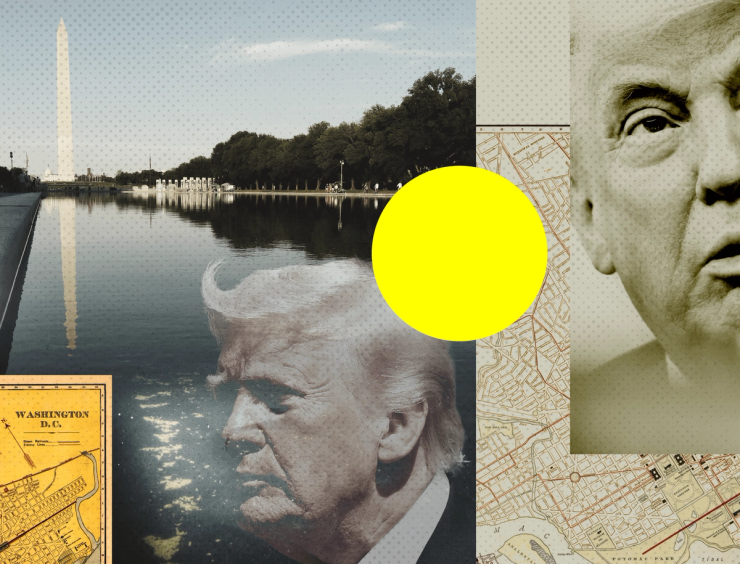


The Scene
On August 3, 2023, Donald Trump was seated in the back seat of a Chevrolet Suburban, on his way from the airport to the E. Barrett Prettyman Courthouse on Constitution Avenue in Washington, DC. Facing arraignment on four charges related to his efforts to overturn the 2020 election, he looked out the window and saw a US capital that had been slow to recover from COVID-19 and was bucking a national decline in crime.
The ex-president saw shattered tiles in the roadway and homeless people sleeping on street corners in a city whose police department had recommended drivers stay in the middle lane to avoid carjackers. At one point, the vehicle swerved to avoid bricks and concrete dumped in the middle of the road.
It was on that ride, an official with him on the campaign trail to reclaim the White House now believes, that the real estate developer-turned-president developed a new fixation with what he regarded as a second-tier swamp town that had slouched into its status as imperial capital.
Trump’s obsession with Washington has taken on even greater centrality as, 17 months into his second term, he slams into the limits of his power as US president. Mired in a complicated effort to end the Iran conflict, he’s also fighting with a Republican-led Congress that had previously bowed to his demands and is dealing with stubbornly high inflation rates. He’s had to swallow decisions by a Supreme Court that have placed limits on his tariffs and this week ruled against his efforts to overturn birthright citizenship for undocumented migrants. The summer’s political bestseller portrays him as a figure whose transformative potential has been utterly derailed by hubris.
But there’s one space where Trump retains enormous latitude: the physical footprint of DC. That’s evident in the 92-foot “Claw” that he had erected on the South Lawn in June for a UFC fight, the $600 million White House ballroom renovation, the newly painted deep-blue reflecting pool, and the massive 16-day Great American State Fair on the National Mall for the US’ 250th anniversary.
Where previous presidents have passed through Washington, taking pains to assure voters they are merely visitors, Trump is imposing a vision on Washington with a clarity and forceful execution that have evaded him in other parts of his job. The changes will likely have a lasting impact, according to interviews with nearly a dozen advisers, people close to and formally in the White House, and others involved in Trump’s DC makeover.
“How fitting as we go into our 250th that President Trump is personally involved in making sure that our capital reflects the greatness of our country,” Interior Secretary Doug Burgum told reporters last month as he stood alongside Trump, who rattled off in minute detail how he was sandblasting granite sidewalks, planting new grass, and cleaning graffiti off fountains. The renovations, he said, show Trump refusing to accept any evidence of American decline.
Trump has been thinking about Washington for years. In the decades following the 1976 bicentennial, Trump would sometimes lament that the festivities for the country’s founding had been “underwhelming,” said Michael Caputo, a longtime adviser and ally, recalling a conversation with the president at Trump Tower just before Independence Day 2014. “He’s said that he thought our country could have done a much better job celebrating [it],” Caputo said.
Back in 2010, Trump pitched the idea of a ballroom to the then-President Barack Obama’s administration, even going so far as to speak to Obama’s senior adviser at the time, David Axelrod. Trump offered to manage the project himself, and Axelrod said he regretted never getting back to him.
In 2014, Trump was considering running for New York governor. Some aides were pushing him to run for president in 2016 instead. Caputo recalled Trump remarking then that “if he’s president for two terms, it’s a shame that he would not be the president to lead the 250th celebration.”
Trump’s 2020 defeat and unusual split term solved that problem.
An expanding campaign
Last Sunday, Trump donned a baseball cap and zip-up to join Burgum on a tour of renovations at Lafayette Park and DC’s East Potomac Golf Links. As rain drizzled and the humidity bore down, the president peered at blueprints for the public golf course, before driving to his own course in Virginia via the Arlington Memorial Bridge, near where his Triumphal Arch may soon be built.
His campaign of municipal repair is ongoing and constantly expanding. “When he’s motorcading around town, he points stuff out,” one administration official says. Trump regularly references construction projects during unrelated meetings and has shown lawmakers his plans for the ballroom or other projects. And it’s not uncommon for him to keep architectural mock-ups and samples on his desk, sometimes directing aide Natalie Harp to fetch props.
During a recent sit-down with The Daily Caller, Trump summoned Harp to help him show off gold-encrusted frame samples and then asked a reporter whether they thought he should put a photo of an autopen in place of former President Joe Biden’s picture on his “Presidential Wall of Fame.”
“He talks about it in pretty much every press gaggle or availability that he does,” one former White House official said of the DC makeover.
Those familiar with Trump’s focus on the city say that it’s one part of this presidency he genuinely enjoys. “We know that he was a builder at heart,” the former official said. “This is clearly something the president cares strongly about.”
But the city’s makeover has come with costs. Trump has redirected federal money to help finance billions of dollars of renovations, shifting hundreds of thousands of dollars in funds from National Parks and other programs. The administration has proposed a $10 billion fund for DC projects, including beautification efforts. And the cost of the White House ballroom has climbed in recent months, with reports indicating that taxpayers may foot a portion of the bill.
If Democrats flip the House this fall, they’re vowing to include some of the projects in their investigative sweep.
“We should have some oversight about who these contracts are going to, that they’re not no-bid contracts, that there’s proper management of those funds,” said Rep. Ro Khanna, D-Calif., a House Oversight Committee member. (Congress has effective veto power over the local DC government and its budget, but the Interior Department and National Park Service have jurisdiction over the land where many of Trump’s projects are located.)
But members of the Republican majority have been supportive of Trump’s projects, including Oversight Committee Chair Rep. James Comer, R-Ky., who had worked with DC Mayor Muriel Bowser, a Democrat, on issues like public safety and redeveloping the former Robert F. Kennedy Memorial Stadium.
“Anytime you can beautify the city, I think that’s a good thing,” he said.
In a statement, the Interior Department defended the shift of funds from national parks, with a spokesperson saying it “has many funding sources available to spend on deferred maintenance.” The spokesperson noted that Park Pass revenue from sales is up for the first quarter of the year compared to the year prior.
‘We’re going to stay here for a while’
If you ask Trump’s allies why he’s so focused on Washington, they may point to his career wedging hotels and skyscrapers into the New York City skyline. Or they’ll explain how he wants to restore the neglected nation’s capital to a place of glory, where foreign officials and tourists can visit and feel safe.
Others point to legacy. The president, with America’s 250th celebration, has an opportunity to reshape the city of Washington without the kind of roadblocks that have at times slowed his national efforts.
“Safe, clean, and beautiful” became a promise he repeatedly reiterated on the campaign trail during his most recent presidential race. An executive order titled “Making the District of Columbia Safe and Beautiful” quickly followed once he was in office, prompting a swath of federal agencies to launch a task force to carry out his vision in the spring and summer of 2025. The Interior Department began clearing homeless encampments and removing graffiti from federal property.
Bowser, who declined to be interviewed for this article, urged the administration to clean up federal parks and fix broken fountains, while pushing back on measures like having police ask for people’s immigration status.
“Just seeing the level of degradation that has happened to our city over the last few years,” said the former White House official, “it just got to a point where someone had to step in and fix it.”
But as the summer wore on, Trump privately grew frustrated by a string of high-profile incidents that kept popping up on national news. In one, a 19-year-old former Department of Government Efficiency employee was injured in an attempted carjacking.
“Bring me ideas to make it safe,” Trump began to tell his aides during meetings about the city, according to one person present.
Within days of the early August carjacking, a more aggressive plan was announced, led in part by deputy chief of staff Stephen Miller. The administration boosted federal law enforcement for city patrols and then announced a crime emergency, taking control of DC’s police department and ordering an influx of roughly 2,000 National Guard troops.
Bowser argued the efforts were unnecessary, citing a drop in crime numbers from a 2023 peak; The Trump administration countered that crime in the city remained too high. “We’re going to stay here for a while,” Trump said at a gathering of DC police that month.
The anti-crime takeover led to more arrests, including on immigration-related offenses, and data showed a drop in violent crime, homicides, and carjackings compared to the year prior. A May report from the nonpartisan Niskanen Center found that DC crime fell substantially, attributing the drop in part to changes in local policing strategy. The ongoing National Guard experiment, the report found, has resulted in fewer opportunistic and property crimes.
As he declared his crime-busting tactics a success, Trump shifted to larger-scale projects that prompted louder criticism.
Critics argue that the 90,000-square-foot East Wing ballroom is too large and gaudy for the White House and note that it required the demolition of a key part of the building. The Trump administration defends the project as a much-needed addition.
“He’s blowing it up to a proportion that just massively exceeds anything that they wanted to do,” Edward Lengel, the White House historian during Trump’s first term, told Semafor of some of the president’s architectural plans. “So he’s riding the pony of civic beauty, but then he’s using it to kind of vault himself into a whole new stratosphere, something that is all about Trump.”
Likewise, the proposed Triumphal Arch has grown in scale and faces lawsuits arguing it’s a vanity project. “There could not be a more hallowed ground in the country than Arlington Cemetery,” said Calder Loth, a plaintiff and retired architectural historian. “And you’re faced with this biggest arch in the world, right smack in front of it, blocking the vista that existed for 200 years.”
Most recently, Trump caught flack for the more than $16 million renovation of the Lincoln Memorial Reflecting Pool after the paint began peeling and algae started discoloring the water. Trump has accused vandals of ruining the pool, and redirected officers to police the area.
But the pushback hasn’t blunted Trump’s ambitions. The National Guard remains in the city, with no end date, and ballroom construction continues.
Meanwhile, ahead of the 250th celebration, the administration says it has so far restored 22 fountains and water features; cleaned 45 monuments and memorials and 28 historic statues; removed 154 homeless encampments and over 500 instances of graffiti; installed or fixed over 1,100 benches, and fixed nearly 1,700 lights around the city.
“For the first time in decades, America’s capital — long forgotten and shamefully neglected — has been dramatically transformed,” said White House spokeswoman Taylor Rogers. “Historic landmarks such as fountains, parks, memorials, monuments, and public spaces have been restored to pristine, world-class condition, allowing Americans from all across the country to enjoy them again with a great sense of pride.”
In this article:

Shelby’s view
Trump’s DC takeover encapsulates, on the small but permanent scale of real estate, how the 47th president is trying to leave a mark on Washington that — unlike most everything else in US politics — can’t be undone. His expensive and ambitious campaign has been conducted with little congressional consultation or oversight, shaped entirely by one man.
Commentators like political scientist Ian Bremmer may suggest that America has passed peak Trump. But his Washington project is only getting started. And unlike some of Trump’s other efforts, this one appears likely to continue, even as Congress, the courts, and falling public opinion constrain other aspects of his presidency.
Because Trump governs primarily through executive action, not legislation, it’s easy to envision a successor reversing the US exit from the World Health Organization or the dismantling of the Department of Education. But it’s much harder to tear down a ballroom (even if some prospective 2028 Democratic candidates have suggested the idea). You can almost picture a future President Alexandria Ocasio-Cortez or Gavin Newsom hosting a state dinner in Trump’s grand ballroom, with a Trump Triumphal Arch down the road. Trump’s legacy in DC is going to be difficult to erase.