




David’s view
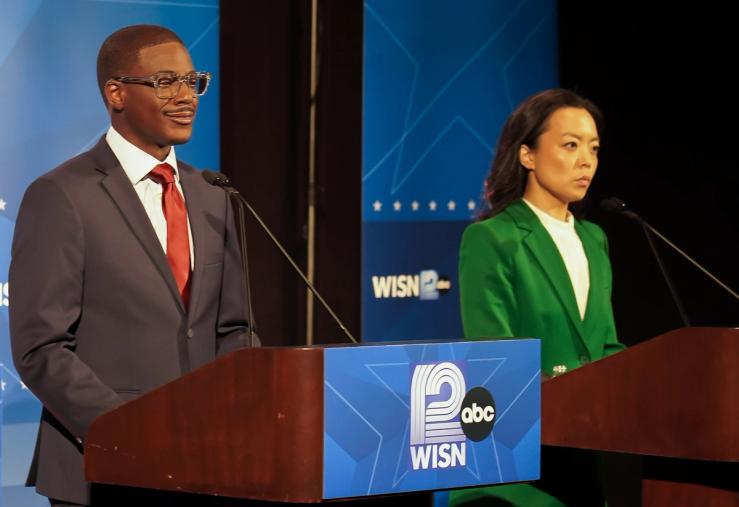
Over the last few days, as Francesca Hong’s Wisconsin gubernatorial campaign came undone over a tweet condemning the colonialist origins of Thanksgiving, I flashed back to September and a debate between two Democratic strategists.
On one side of the Persuasion 2025 stage was Sarah Longwell, a former Republican who’s now publisher of The Bulwark. On the other was Anat Shenker-Osorio, a progressive messaging guru who advised the Way to Win donor network — the hosts of the conference — on how to move voters.
Longwell argued that Democrats needed to change the way they talk, un-learning the elitism of John Oliver and college-town coffee shops: “When you ask voters about Democrats, one of the things they’ll say is: ‘I don’t know, they sound like aliens.’” Shenker-Osorio countered that Democrats were fighting a fascist threat and needed to say so: “What you need is a message that will make people stop scrolling or sit up and listen in the first place.”
It was the post-Biden Democratic dialectic in one room. Did the party go too far left and alienate working class voters? Or did it wimp out and convince those voters that it was too scared of Republicans to fight for them?
This is a helpful way to think about the party’s argument about “wokeness” and the legacy of the social justice movements of 2020. The weaker Democratic faction believes the party moved too far to the left then and must convincingly recant to win back votes; the stronger faction believes this argument is a distraction whipped up by Republicans.
What the weaker faction figured out, just in time to beat Hong, is that very few Democrats want to own what they said in 2020. Few believe that better social welfare could make police and prison unnecessary, as the left argued six years ago. Very few think that America was truly founded when the first slaves arrived in 1619 and that patriotic holidays are oppressive.
The proponents of those ideas believe that spreading them can shift the boundaries of debate — that nothing else will do so in a media environment where conservatives hold enormous power. But many left-wing Democrats have stopped trying to spread them. They’ve become much more skeptical of “woke” language, seeing it as a top-down, elite-driven effort to snuff out economic populism.
Hong’s narrow defeat in Wisconsin, by a candidate who had suspended his campaign until Gov. Tony Evers told him to get back in, revealed how many Democrats worry that they’ll lose if they “talk like aliens.” And they think that in 2020, they kind of did talk like aliens.
Unlike Michigan’s Abdul El-Sayed, a brash and confident communicator who talked about living a “100% American” life, Hong didn’t easily give up on the ideas she had in 2020. Rep. Alexandria Ocasio-Cortez, D-N.Y., who endorsed El-Sayed, did not back Hong.
On ABC, Ocasio-Cortez laughed off a question about Hong’s Thanksgiving and policing statements by quoting an ally who serves on the New York City council: “Woke One was crazy.
“When we talk about crime today, it’s fundamentally different than the way that we talked about crime in bringing crime down, right?” Ocasio-Cortez said. This was confusing, but sounded like a reference to the 1990s Democratic rhetoric about crime that Hillary Clinton and Joe Biden used at the time, then eventually abandoned.
“I think that we all share in the goals of having as low a crime rate as possible,” Ocasio-Cortez continued. “I think that, you know, during lockdown, of course, rhetoric in that time is not rhetoric that we would use today.”
This was a climbdown from her 2020 position, and an admission that her movement had used alienating language and ideas during a short-term, revolutionary moment. Radical rhetoric had grabbed attention more successfully than cautious rhetoric, forcing big ideas about crime, race, and gender into the public discourse. That turned out to be a problem for the left’s more important cause, of economic justice, and it had to go.
The left’s enemies inside the Democratic Party would like some more contrition from the people who adopted this rhetoric. What they have, instead, is a sort of compromise: The left is admitting that it gave Republicans too much ammo in 2020, but it’s trying to change the subject now so that the ammo doesn’t hit.
A version of that happened in Minnesota this week, where progressives romped in Democratic primaries. Lt. Gov. Peggy Flanagan, who beat Rep. Angie Craig for the party’s Senate nomination, knew that Republicans would go after her over wearing a T-shirt with the slogan “Protect Trans Kids,” and the image of a combat knife, to a 2023 bill signing.
When I asked Flanagan about the GOP focus on that image, she said that Republicans who talked about it had “an interesting strategy to distract from the fact that the economy is in the toilet.” In 2026, she wasn’t eager to use that imagery again and talked about the topic differently.
“I wore a shirt,” she said. “What I think people need to know is that I’ve had a lot of conversations with young people who sometimes think that things would be better off if they weren’t here anymore. That, to me, is unacceptable.”

Notable
- In the Milwaukee Journal Sentinel, Craig Gilbert analyzed the vote breakdown and patterns from the primary. “Crowley’s big upset after trailing badly in the polls forces everyone to recalibrate for the fall, including Republicans, who were clearly hoping to run against Hong.”
- In the Minnesota Reformer, Max Nesterak looked at how Flanagan won so decisively. “She energized the party’s base and won its convention endorsement with a soaring progressive platform: Medicare for all, universal childcare, a path to citizenship for undocumented immigrants.”