



The News
JACKSON HOLE, Wyo. — Federal Reserve Chair Kevin Warsh made his debut Friday on one of the global economy’s biggest stages, where he appeared to play the hawk.
But looks can be deceiving.
Warsh used his first speech at the Kansas City Fed’s storied economic policy symposium in this mountain town to cast doubt on the argument — often pushed by the president who tapped him — that prices are cooling enough to consider lower interest rates. The central bank chair said that recent inflation data provided little comfort and “markets are showing few signs of policy restraint,” indicating to investors that he could support a rate hike next month.
“We must be confident that underlying inflation is moving to our objective, clearly and at sufficient speed. Otherwise, we have work to do,” Warsh said.
It was surprising candor about the future from a Fed chair who recently scrapped the bank’s practice of providing so-called forward guidance about its next moves. Yet the speech didn’t go materially further than Warsh’s comments about rising prices last month, before the central bank elected to hold rates steady.
What resulted was a divided audience for Warsh. Short-term Treasury yields bumped up Friday as investors read his speech as proof the central bank could soon raise interest rates. Among attendees of the conference, however, a clearer skepticism emerged about Warsh’s endgame.
“There were three key words missing from Chair Warsh’s remarks: accountability, credibility, and responsibility,” Peterson Institute for International Economics President Adam Posen said in an interview on the sidelines of the conference.
“If you are insisting that the best thing to do is to make up your mind at the last minute in a non-transparent way, which has no consistent record, you are avoiding accountability for your past mistakes,” Posen added, referring to the end of forward guidance. “And it’s very hard to see if you’re learning.”
Another attendee, American Enterprise Institute Director of Economic Policy Studies Michael Strain, said that Warsh’s Jackson Hole speech “raises the stakes for the September meeting: Markets are looking for clarity, and it remains to be seen whether this speech will provide additional clarity or additional confusion.”
Beyond the topline, Warsh’s speech offered his fullest account yet of how he views the Iran war, President Donald Trump’s new tariffs, and the AI buildout affecting prices. Since his confirmation earlier this year, the central bank has split further on whether inflation is truly transitory; last month’s decision to keep rates steady resulted in the most dissents since 1970.
“Call it an outline, call it a trail map, but please just don’t call it forward guidance,” Warsh said with a smile.
In this article:

Know More
The Jackson Hole conference has brought the world’s most influential voices on economic policy to the heart of Grand Teton National Park for an elite dialogue about the year ahead. This year, though, they weren’t sure if their new guest of honor would pony up.
Warsh spoke amid heightened financial uncertainty that’s getting amplified by unanswered questions about the Trump administration’s plans to intervene in the bond market. Treasury Secretary Scott Bessent, the steward of those bond buybacks, skipped this year’s conference ahead of G-20 talks in North Carolina.
The new Fed chair sidestepped Bessent’s bid to bring down bond yields on Friday; still, it cuts across his own efforts to reduce the Fed’s balance sheet and risks undercutting any future decision to tighten monetary policy.
Former Fed Vice Chair for Supervision Randal Quarles told Semafor that “it would be premature for Chairman Warsh to talk about” any coordination with Bessent until the Fed’s new task forces “have finished their work.”
But collaborative efforts, such as the syncing of Treasury issuance with Fed purchases, would reassure investors that “that’s not one institution dominating the other,” he said.

Step Back
The new Fed chair’s Trump-friendly image didn’t change much about the tradition-bound event. Organizers impose strict limits on the guest list and tweak it slightly each year, occasionally excluding past participants even if they’ve made the trip for decades.
“I never, ever take it personally,” KPMG Chief Economist Diane Swonk, who wasn’t invited this year despite attending “probably 20″ past symposiums, told Semafor.
Some have “called up and yelled at the Kansas City Fed — and I mean it’s just kind of silly, because the reality is, you want to shift things up a little bit,” she said. “You want to get more diverse views. You don’t want just the same people showing up every year.”
Banks got the axe in the wake of the Great Recession. Now the rotating cast of 100 or so attendees is limited to current and former central bankers, government officials, and top economists (plus a dozen-ish reporters).
This year, current and former monetary policymakers from across the US will huddle with their counterparts at the European Central Bank, as well as the central banks of England, France, Canada, Mexico, Japan, South Korea, Saudi Arabia, Argentina, and more. Administration officials like Council of Economic Advisers Chair Chris Phelan were on the list, too.
The theme of this year’s event: financial innovation and its “implications for payments and policy.” That means conversations about how tokenization might affect payments, regulatory and monetary policy, central banking and more.
Also on tap: group hikes, float trips, and bear sightings. Warsh, despite his arrival as a disruptor of Fed protocol, embraced that summer-retreat spirit.
“The best thing about this gathering is that it helps us all get out here to the mountains and clear our minds and think straight about our world and our time,” he said in his speech.

Eleanor’s view
Warsh’s aversion to forward guidance will be harder to maintain with each speech like Friday’s. It’s common for Fed chairs to avoid committing themselves to an outcome before they need to; it’s less common for them to deprive investors of any meaningful indication of how they’re thinking about the underlying forces buffeting the economy.
Meanwhile, Bessent is countermessaging Warsh by suggesting that the markets — rather than offering truth — may be steered by “bad information.”
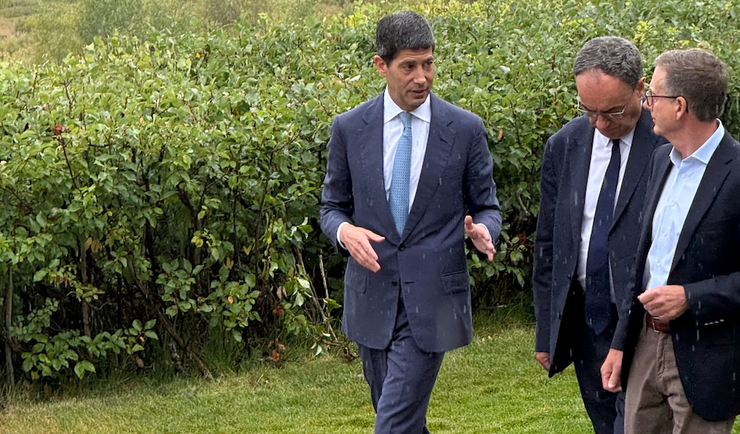
But even during a trade war, Jackson Hole remains a place for economic policymakers from around the world to break bread. Take Tiff Macklem, head of the Bank of Canada, who took part in a photo op with Warsh despite the punishing tariffs their nations are imposing on each other.

Notable
- US stocks were mostly unchanged following Warsh’s remarks, the Associated Press reports.
- Indeed, Fed chairs’ Jackson Hole speeches rarely surprise stock markets, Bloomberg reports.