




The News
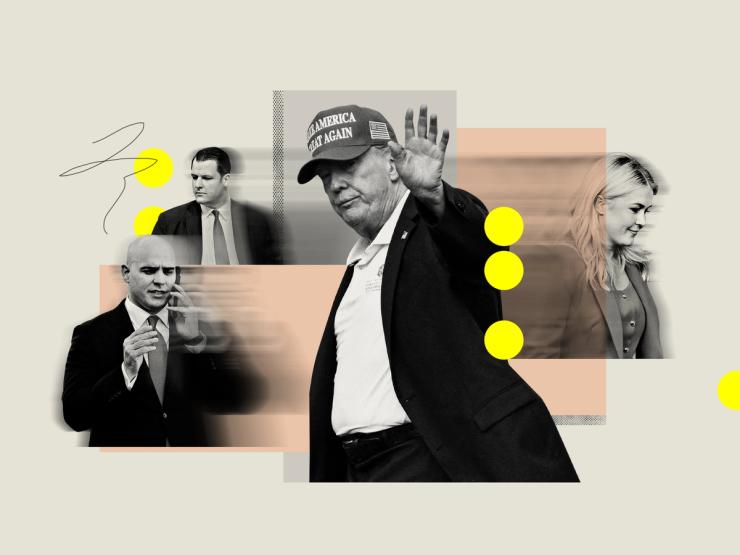
When Vanity Fair published close-up photos of President Donald Trump’s core advisers at the end of 2025, the group included five staffers alongside the vice president and secretary of state. Now two of those five aides are gone from the West Wing, turnover that’s reshaping the management of a deeply personal presidency.
Two more advisers, each of whom holds the president’s trust, are also leaving the White House within weeks. The trend is familiar to many presidents heading into their final two years in office, but the stakes of a shrinking inner circle may be higher for Trump because of the ecosystem that’s defined his second term: Only a handful of advisers have direct, frequent access to him.
That’s by design, after a chaotic revolving door of first-term administration departures that ingrained Trump’s intense focus on loyalty. As one former administration official said, the aides who remain in the White House “want to keep things tight and in the family.”
A small family, however, means that the president is facing a tough midterm election with record-low approval ratings, a flurry of distracting personnel dramas, a trade war to the north, and an unresolved war in the Middle East — all with a tinier group of people in the building whom he truly trusts. And the absence of even one gatekeeper risks exposing Trump to the influence of figures with their own ideas for his agenda.
The list of departures is topped by White House press secretary Karoline Leavitt and deputy chief of staff James Blair, who departed in April. But it includes critical Trump advisers who are photographed more rarely: James Braid, director of legislative affairs, is departing next month; David Warrington is also about to step down as White House counsel.
Inner circle members still at his side include chief of staff Susie Wiles, deputy chief of staff for policy Stephen Miller, Vice President JD Vance, Secretary of State Marco Rubio, and communications director Steven Cheung.
As power consolidates among the remaining players, one administration official familiar with the scenario said, “the people that have been with POTUS the longest will benefit.”
Semafor spoke with more than a half-dozen current and former Trump officials, as well as people close to the White House, about the power structure that surrounds Trump. Many around him contend that things won’t shift much, because the president can still pick up the phone to reach his departed confidants.
Leavitt and Blair, for example, aren’t going far; they will be advisers to the president’s outside political operation. One White House official described a “pretty large” group of aides in contact with him, including people who report to senior leaders.
Others, like the first administration official, argued that Trump’s reality is one of shaky object permanence.
“Once the president has not seen someone for a while, especially if they’re not people he has a longstanding relationship with,” the official said, “he’s not really going to be hungry to call them.”
Inside the White House, Wiles remains the center of gravity and a critical player in resolving crises of all sizes. But even her awareness can’t be constant, as shown by a scene that played out just this summer.
When Wiles left the capital for her daughter’s wedding on one late June weekend, Homeland Security Secretary Markwayne Mullin saw an opportunity. Mullin, with Wiles and other top aides away, pitched Trump directly on his preferred choice to take the politically volatile post of Immigration and Customs Enforcement director: Lance Schroyer, formerly the head of the security detail at Mullin’s Oklahoma home.
Trump made the pick official on Truth Social that very same weekend — a decision that surprised most others close to him, several sources told Semafor.
A source familiar with the situation said that Trump makes his own decisions about nominees and hears from various advisers on the subject.
“This movement is bigger than any one staff member, and the President’s mission to make America greater than ever before will continue unabated,” White House spokeswoman Taylor Rogers said in a statement.

Activating the ‘stopgaps’
At the heart of the smaller inner circle is a workflow challenge familiar to anyone in management — how many unregulated requests, how much unfiltered information, should reach Trump before he makes a choice?
The White House official said that, in a key difference from Trump’s first term, the administration has “stopgaps” designed to ensure that oversight takes place, even when “some people may slip something in.”
In the case of Schroyer’s ICE nomination, the president was “given more information,” the White House official added.
That stopgap may result in a failed nomination. While Schroyer remains Trump’s nominee, several sources told Semafor that conversations are ongoing about whether to pull him amid questions about his lack of federal experience.
“Lance Schroyer remains President Trump’s nominee to lead ICE. Congressional scheduling should not be interpreted as any personnel announcement,” a second White House official said.
But some allies sense the White House losing a step.
“You’ve begun to see a deterioration of the tight ship that was run in the first year,” one person close to the White House said, adding that staff changes in the West Wing will be a good thing.
“I think you need fresh minds, I think you need fresh ideas, I think you need people who are going to come in who are hungry again,” this person added. “A lot of people are f*cking obese now, from the power and from the influence.”
Beyond the gatekeepers
It’s been a stressful August for a White House messaging operation sidetracked by responding to internal dramas.
A remark about Trump’s executive assistant Natalie Harp by Sen. Jon Ossoff, D-Ga., snowballed into multi-day news coverage of her infatuation with the president; one negative story about Defense Secretary Pete Hegseth’s wife prompted swift public pushback from administration officials; and a Daily Mail article reporting on criticism of Morgan DeWitt-Snow, a little-known White House personnel official, was quickly followed by a glowing Breitbart story about personnel chief Dan Scavino.
During this summer alone, eight White House aides have announced their exits. That number includes Braid, Warrington, and Leavitt, who’s departing to focus on her small children, as well as several aides just outside the inner circle: Andy Baker, deputy national security adviser; Abigail Jackson, a key Leavitt deputy; Emily Underwood, a senior deputy to Miller; Pace McMullan, deputy legislative affairs director; and Sriram Krishnan, who helped shape AI policy.
While searches are underway for Leavitt and Braid replacements, and a group of younger players is eager to step up, few people who know Trump believe he’s ready to open up to new arrivals.
Sean Spicer, one of his first-term press secretaries, didn’t necessarily see that as a bad thing. Spicer acknowledged that some senior staff changes could leave a mark but aligned with several current and former aides who described Trump as comfortable enough in his gut instinct to rely on a small circle.
“The president’s comfort in the job is exponential to what it was in Trump 1.0,” Spicer said.
‘All roads lead back to Boris’
The consolidation of power that’s now underway promises to benefit at least one Trump loyalist.
When the president returned to office, some officials saw various “power centers” that made up his legal team. One was led by Boris Epshteyn, Trump’s senior personal counsel, another by then-Attorney General Pam Bondi, who was close with Wiles, and another by Warrington, a conservative lawyer who had opened up a 2024 investigation into Epshteyn that resulted in no action against him. (Epshteyn denied any wrongdoing.)
Now Bondi and Warrington are gone, and Epshteyn allies have replaced both of them: Todd Blanche is the new attorney general, and Will Scharf, the president’s staff secretary, is the next White House counsel.
“All roads lead back to Boris,” as the administration official put it.
Epshteyn, importantly, is a longtime fixture in Trump’s world. Other, more peripheral allies of the president have also ascended over the past year to wield more outside influence on certain issues — among them, Republican operative Roger Stone.

Shelby’s view
Trump’s advisers matter because of their proximity to Trump. So it’s important to remember that the president’s persona remains relatively constant, despite the shifting cast that surrounds him.
He is defined, more than anything, by his reluctance to back down when he chooses a path. That’s evident in Iran, and just as clear in his willingness to go after longtime US allies on trade.
Many of the pitfalls that Trump is confronting trace back to that tendency to dig in, more so than any one staffer’s departure.

Notable
- Beyond his close circle, Trump has seen 11.4% of his Senate-confirmed appointees leave the administration in his second term so far, a number that far outpaces his first term, according to Partnership for Public Service analysis covered by GovExec.