




The Scene
Gulf officials have been at pains to state that the Iran war won’t create any distance between the region and its most important economic and security partner, the US. The reality is more nuanced: Washington remains the dominant player in the Gulf, but the conflict is providing an opening for China.
The US has pushed Gulf allies to limit the use of Chinese companies in technology and defense as Washington seeks to contain Beijing’s rise and retain its own position in the region.
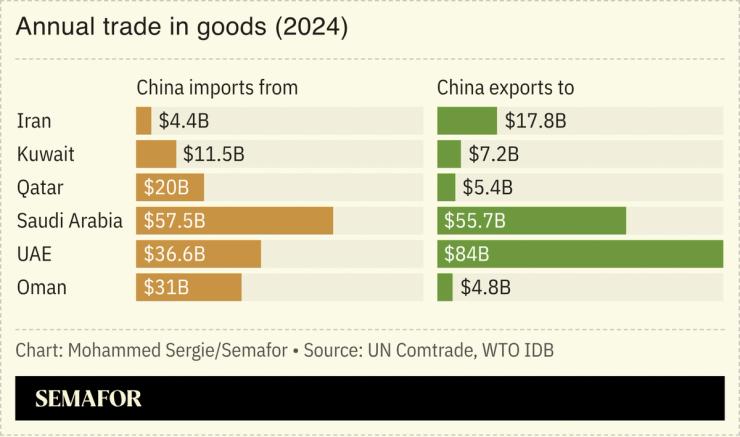
But as the Gulf — and Iran’s — biggest trading partner, China is expanding its role as a source of foreign direct investment, infrastructure financing, and industrial partnerships. And as a key ally of Iran — the Gulf’s top strategic adversary — Beijing is seen by many in the region as having leverage. It was China, after all, that reportedly pressed Tehran to enter the ceasefire with the US, and it has more to lose economically than the US if the conflict persists.
In this article:

Matthew’s view
Gulf officials — particularly in Saudi Arabia — often say the US is their preferred partner. But the relationship is complicated, and it shifts based on administrations, domestic US politics, and personalities. Former US President Joe Biden vowed to make Saudi Arabia a “pariah,” then changed his mind and turned up in the kingdom for a fist bump with Crown Prince Mohammed bin Salman. President Donald Trump recently said in a speech addressing the Saudi business elite in Miami that their crown prince “didn’t think he’d be kissing my ass,” a statement that’s beyond the limits of decorum the monarchy expects from a close ally.
There’s none of that with China, where the relationship is much more predictable.
This doesn’t mean Beijing can replace Washington. The war has demonstrated many American weaknesses, but its military prowess and air defense technology have protected the region from much greater devastation. The US lead in AI, and the Gulf’s desire to convert its energy into tokens, also keeps the region close to Washington.
China knows that the Gulf is unlikely to stray too far from the US in these crucial areas. But there’s still room for Beijing to expand its influence by helping the region develop automotive, manufacturing, and renewable energy industries, taking advantage of a large market that isn’t subject to oscillating tariffs and shifting politics.
When Trump visited the Gulf last year he left with trillions of dollars in investment pledges. He will be looking for deals during his visit to Beijing this week. China is pursuing its influence in the Gulf, and the world, more quietly, and when it comes to gaining share in the region, it may be more effective.

Know More
Bilateral trade between the Gulf and China eclipsed Gulf trade with the West for the first time in 2024, and has grown more than 250% since 2010, according to a report by think tank Asia House. Chinese FDI into Saudi Arabia has soared too, making the country one of the kingdom’s top investors behind the US.
Even the UAE, which was most forceful in signaling its intention to double down on its relationship with the US, has publicly shown it also wants to grow closer to China.
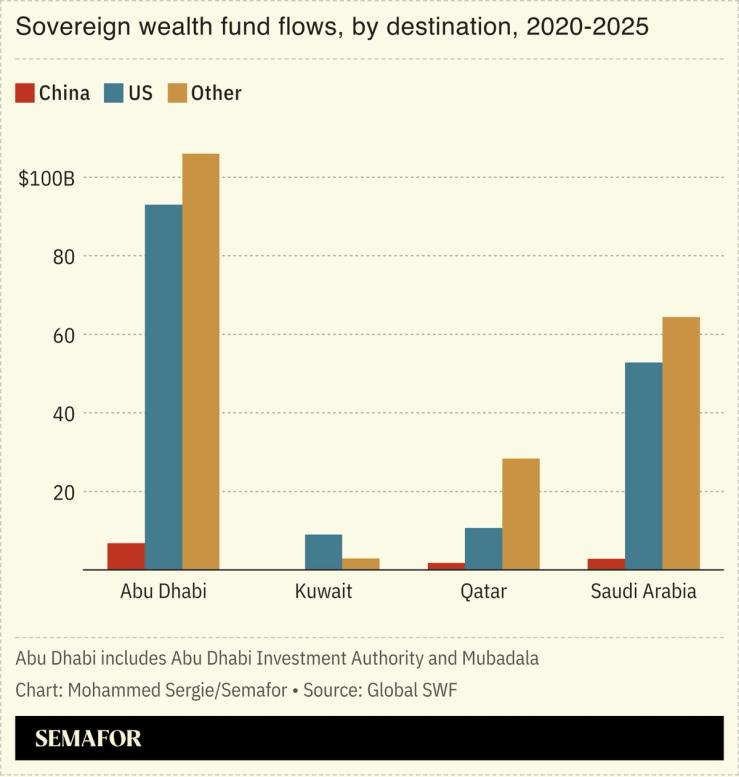
While the US is still overwhelmingly the number one destination for Gulf sovereign wealth, there are several signs that flows to China will pick up in future.
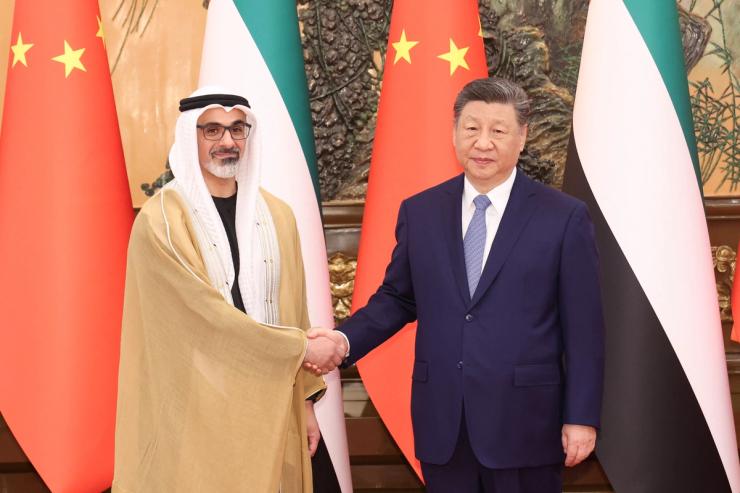
Abu Dhabi Crown Prince Sheikh Khaled bin Mohamed visited China in April, and the emirate is considering plans to consolidate some Chinese assets into a new vehicle as it looks to boost exposure to the country. Chinese media portrayed the visit as evidence that the UAE was looking for “more reliable partners.”
Chinese leader Xi Jinping visited Riyadh in 2022, and later helped broker Saudi Arabia’s rapprochement with Iran. While that agreement looks in tatters now, there are few signs the kingdom is looking to reevaluate its China ties. In fact, Saudi Arabia’s Public Investment Fund opened a second mainland China office to help it source investments into the world’s second largest economy, and attract Chinese capital into the kingdom.
As the Gulf looks for ways to recover from the war and the closure of the Strait of Hormuz, China is likely to play a role in rebuilding infrastructure, investing in new trade routes, and leveraging the region’s ambitions in manufacturing and critical minerals to support its own global ambitions.

Notable
- Washington’s failure in Iran, and Tehran’s rise as a key player in the region, will strengthen China and Russia and accelerate the shift to a “post-American world,” Robert Kagan writes in The Atlantic.